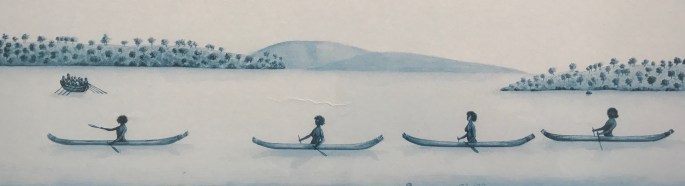
Tuai: A Traveller in Two Worlds. By Alison Jones and Kuni Kaa Jenkins. Wellington: Bridget Williams Books, 2017. Pp. 288. NZD$45.00 paper. This lushly-presented, award-winning book is a biography of a commonly cited but little researched early Māori globetrotter. Tuai was a Ngare Raumati chief from what Europeans named the Bay of Islands. Born around … Continue reading Review of Tuai
Blog
Discrimination and Gaslighting in the 2018 ARC Controversy
I was pleased to contribute to this collective response to the ministerial intervention into 2018's Australian Research Council grants. My bit below; published in the November issue of the Australian Book Review: "In the ongoing furore around revelations of ministerial research grant vetoes, two things are in danger of slipping from view. One is that … Continue reading Discrimination and Gaslighting in the 2018 ARC Controversy
The Humanities and 20 Years of Australian Political Culture
Just over a year ago I launched my personal website with a brief commentary on two media pieces that struck me as especially important and succinct. They focussed on the value of the humanities and other neglected forms of labour in our increasingly automated age. With it, I solidified one friendship and made another, and … Continue reading The Humanities and 20 Years of Australian Political Culture
Yearly Faves
My non-professional reading Every year I try to compile, for my own benefit really, a list of my top five non-work-related reads. For 2025, I included some older ones. The standout novel, though, was Ian McEwan's What We Can Know, which is so thoughtful about the future and the humanities and poetry and climate change … Continue reading Yearly Faves
“History Lesson”
Yesterday I found these notes in my inboxes: Hiya Kate - I'm doing a story about the friendship between arthur phillip and bennelong for tomorrow's paper..I'd love to get your input...Chris Hook, Journalist, Daily Telegraph. And: hello there ...I'm a daily tele journalist doing a story for tomorrow about Australia Day and the friendship between … Continue reading “History Lesson”
Cherokees in the Revolutionary Era
In November 2017 I was delighted to be a part of an online roundtable blog on 'Native American Revolutions' hosted by the innovative Age of Revolutions historioblog. It begins: The usual story told of the Cherokees in the revolutionary era is a dire one. Starting with the catastrophic Anglo-Cherokee War of 1760-61, this story traces … Continue reading Cherokees in the Revolutionary Era
Historians on the Automated Future
Consequences for higher education, work, and the care of bodies. That’s a rather grandiose title for this post, which spruiks just two pieces recently uploaded by historians. But I think they are among the best short things I’ve read this year; and they speak unusually well to each other. The first is by Frances Flanagan, an … Continue reading Historians on the Automated Future
Erko History
Some of my colleagues are really good at engaging with local history. Since Australian history is not my speciality, my professional "engagement" tends more towards school teachers and international traveling art shows and so on, rather than the immediate world around me. However, recently inspired by my near-and-dear Australianists, I decided last year to become … Continue reading Erko History
Bennelong’s Contested History
My first foray into the mainstream press was both stimulating and disconcerting. A version of the article appeared here in The Guardian on 8 July. But my original is pasted below... Bangarra’s current production Bennelong opened last week, and tells the first contact story of the Aboriginal warrior. It is exquisite, captivating, quick-paced and deeply moving. But … Continue reading Bennelong’s Contested History
Review of Indigenous Intermediaries
Indigenous Intermediaries: New Perspectives on Exploration Archives. Edited by Shino Konishi, Maria Nugent, and Tiffany Shellam. Canberra: ANU Press and Aboriginal History Inc., 2015. Pp. 205. A$33.00. This books ends with Len Collard and Dave Palmer discussing indigenous terms for ideal approaches to history-making. The Noongar’s sense of kanya and the Kimberley people’s notion of … Continue reading Review of Indigenous Intermediaries